
Your website is one of the most valuable assets your small business owns. It’s often the first place potential customers interact with your brand, learn about your services, and decide whether they trust you enough to make a purchase or inquiry.
However, many business owners build a website once and leave it untouched for years. As technology evolves and customer expectations change, an outdated website can silently reduce leads, lower search engine rankings, and damage your credibility.
A website redesign is not just about making your site look prettier. It’s about improving performance, increasing conversions, strengthening your brand, and creating a better experience for visitors across all devices.
In this guide, we’ll explore 15 clear signs that indicate it’s time to redesign your small business website and explain why investing in an updated online presence can generate long-term returns.
Table of Contents
- Why Website Redesign Matters
- 1. Your Website Looks Outdated
- 2. It Isn’t Mobile-Friendly
- 3. Your Website Loads Slowly
- 4. Visitors Leave Without Taking Action
- 5. Your Branding Has Changed
- 6. Your Search Rankings Keep Dropping
Why Website Redesign Matters
Modern customers judge a business within seconds of landing on its website. If pages load slowly, navigation feels confusing, or the design appears outdated, users often leave before reading your content.
A strategic redesign improves far more than aesthetics. It enhances technical SEO, accessibility, page speed, mobile usability, security, and conversion optimization. These improvements can translate into higher search visibility, lower bounce rates, and increased sales opportunities.
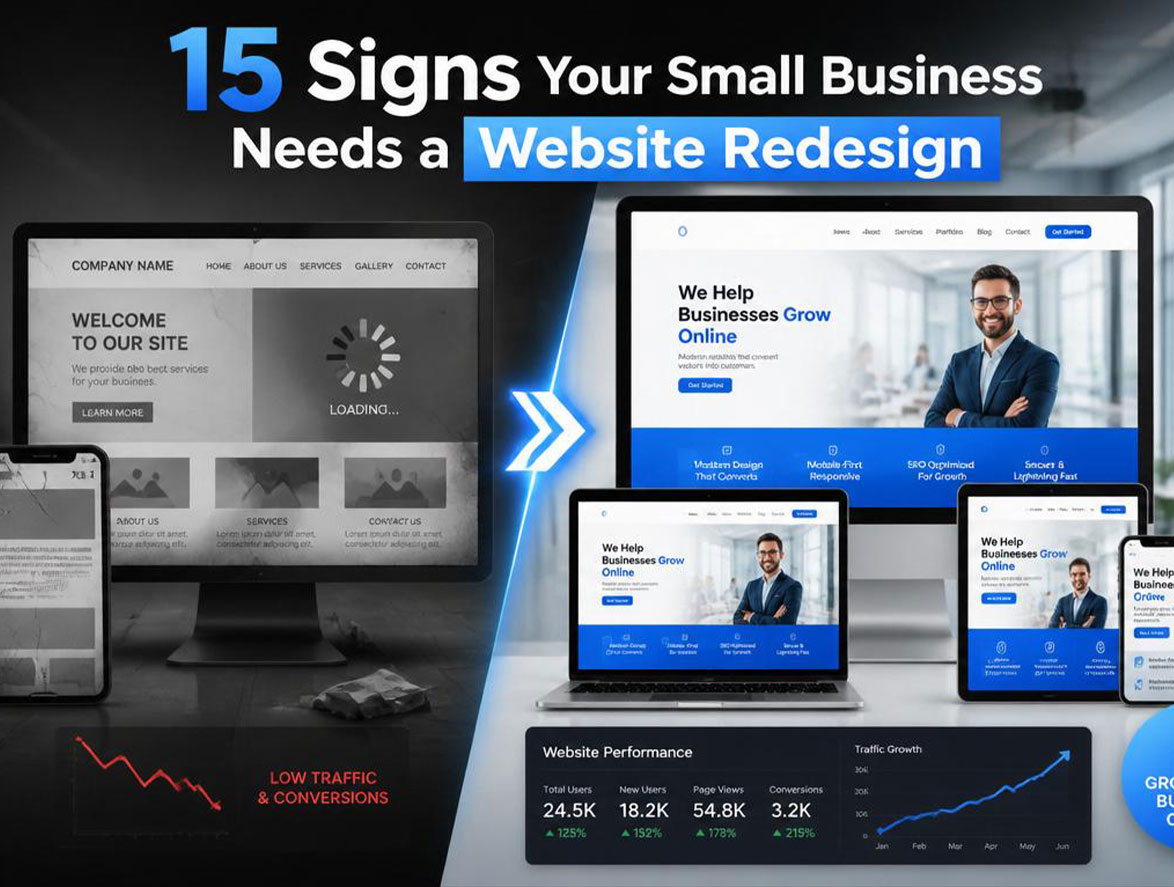
| Outdated Website | Modern Redesigned Website |
|---|---|
| Slow loading pages | Fast and optimized performance |
| Old visual design | Professional and trustworthy appearance |
| Poor mobile experience | Responsive across all devices |
| Low conversions | Optimized calls-to-action |
| Weak SEO foundation | Search-engine-friendly structure |
1. Your Website Looks Outdated
Design trends evolve quickly. A website created five or six years ago may unintentionally make your business appear inactive or less professional than competitors.
Common warning signs include:
- Small fonts and cluttered layouts
- Poor-quality graphics
- Inconsistent colors and branding
- Old-fashioned animations
- Broken layouts on modern screens
Customers naturally associate a polished website with reliability. Even if your products or services are excellent, an outdated appearance can reduce trust before visitors contact you.
Example
Imagine two nearby law firms offering identical services. One has a clean, modern website with professional imagery and easy navigation, while the other features dated graphics and difficult menus. Most users will instinctively choose the first option.
2. It Isn’t Mobile-Friendly
Today, a large share of online traffic comes from smartphones. If users need to zoom in, scroll horizontally, or struggle to tap buttons, they’re likely to leave and visit another website.
A responsive website automatically adapts to different screen sizes and provides an excellent experience across desktops, tablets, and mobile devices.
Common Mobile Problems
- Text that’s too small to read
- Buttons placed too close together
- Images overflowing the screen
- Menus that don’t function properly
- Slow loading on cellular networks
Improving mobile usability not only benefits visitors but also supports better search engine performance and increased customer engagement.
3. Your Website Loads Slowly
Speed plays a major role in user satisfaction. Visitors expect pages to load quickly, and delays often lead to abandoned sessions.
Several technical issues may contribute to poor performance:
- Oversized image files
- Too many WordPress plugins
- Unoptimized code
- Slow web hosting
- Heavy third-party scripts
During a redesign, optimizing these areas can dramatically improve loading times and create a smoother browsing experience.
Quick Tip
Compress images, enable caching, remove unnecessary plugins, and use lightweight themes to boost website performance.
4. Visitors Leave Without Taking Action
Your analytics may show plenty of traffic but very few inquiries or purchases. This often indicates that visitors aren’t finding what they need or aren’t being guided toward the next step.
Effective websites encourage action through:
- Clear contact buttons
- Simple inquiry forms
- Visible phone numbers
- Compelling calls-to-action
- Customer testimonials
- Trust-building elements
If users consistently exit without interacting, redesigning your layout and user journey can improve conversion rates significantly.
5. Your Branding Has Changed
Businesses evolve over time. You may have introduced new services, updated your logo, changed your messaging, or expanded into new markets.
If your website still reflects your old identity, customers may receive mixed signals about who you are and what you offer.
A redesign ensures consistency across your website, social media, marketing materials, and customer communications while reinforcing your professional image.
6. Your Search Engine Rankings Keep Declining
SEO today goes far beyond keywords. Search engines reward websites that offer fast loading times, mobile responsiveness, high-quality content, logical structure, and excellent user experiences.
If your rankings continue to fall despite publishing useful content, technical limitations within your website may be holding you back.
Common redesign improvements include:
- Better heading hierarchy (H1, H2, H3)
- Optimized internal linking
- Improved Core Web Vitals
- Schema markup implementation
- Clean URL structures
- Image optimization
- Enhanced accessibility
Addressing these technical issues can create a stronger foundation for sustainable organic growth and improved visibility in search results.
7. Your Website Is Difficult to Navigate
A confusing website structure can frustrate visitors and make it harder for them to find the information they need. If users have to click through multiple pages just to locate your services or contact details, they’re likely to leave and choose a competitor.
Signs of poor navigation include:
- Overcrowded menus with too many options
- Broken or outdated links
- No clear hierarchy between pages
- Important pages buried deep within the site
- Missing search functionality on content-heavy websites
A redesign should focus on creating an intuitive navigation structure that helps users reach their destination in just a few clicks.
8. Updating Content Has Become Difficult
Your website should grow alongside your business. If publishing a blog post, changing prices, or updating service information requires technical expertise or takes hours to complete, your content management system may be holding you back.
A modern WordPress website should allow you to:
- Edit pages without coding knowledge
- Upload images quickly
- Create SEO-friendly blog posts
- Update products or services easily
- Manage content from a user-friendly dashboard
Easy content management encourages regular updates, which can improve both customer engagement and search visibility.
9. Your Website Doesn’t Reflect Current Business Goals
Perhaps you started as a freelancer and now run an agency, or you’ve expanded from local services to nationwide operations. If your website still promotes outdated offerings or fails to highlight your latest expertise, it may be time for a redesign.
Your website should accurately communicate:
- Your current services
- Your target audience
- Your value proposition
- Your achievements and case studies
- Your latest contact information
10. You Have Poor Conversion Rates
Getting visitors is only half the battle. The real goal is turning those visitors into customers.
If people browse your website but rarely submit inquiries, request quotes, or complete purchases, the design may not be effectively guiding them through the buying journey.
Common conversion problems include:
- Weak calls-to-action
- Complicated forms
- No trust signals
- Poor page layout
- Hidden contact information
A redesign focused on conversion rate optimization (CRO) can significantly increase the value of your existing traffic.
11. Your Competitors Have Better Websites
Customers often compare multiple businesses before making a decision. If competitors provide faster, cleaner, and more informative websites, your business may appear less trustworthy despite offering similar or even better services.
Review competitor websites and ask yourself:
- Is their design more modern?
- Is their messaging clearer?
- Do they explain services better?
- Is their site easier to navigate?
- Do they showcase reviews and testimonials effectively?
A redesign gives you an opportunity to stand out with a stronger brand identity and improved user experience.
12. Your Website Has Security or Technical Issues
Visitors expect websites to be secure and reliable. Frequent errors, outdated plugins, broken pages, or browser warnings can damage trust instantly.
Technical warning signs include:
- Broken links (404 errors)
- Mixed content warnings
- Plugin conflicts
- Outdated software versions
- Forms that fail to submit
- Random website crashes
A comprehensive redesign often includes updating the site’s technical foundation, making it more stable, secure, and easier to maintain.
13. Your Website Lacks Accessibility Features
Accessibility ensures that people with different abilities can comfortably use your website. Improving accessibility also creates a better experience for all visitors.
Examples of accessibility improvements include:
- Readable font sizes
- Proper heading hierarchy
- Descriptive image alt text
- Sufficient color contrast
- Keyboard-friendly navigation
- Clearly labeled forms
Making your website more inclusive can broaden your audience and improve usability across devices.
14. Analytics Show Declining User Engagement
Your website analytics provide valuable insights into visitor behavior. If key metrics continue to worsen, your design may no longer meet user expectations.
Pay attention to metrics such as:
- Increasing bounce rate
- Lower average session duration
- Declining pages per session
- Reduced lead generation
- Falling organic traffic
Rather than treating these numbers as isolated problems, view them as indicators that your website experience may need improvement.
15. You Haven’t Redesigned Your Website in Years
Even if your website appears to function correctly, it may still be outdated under the hood. Technology, design standards, SEO best practices, and user expectations evolve continuously.
If your website hasn’t received a meaningful update in three to five years, consider evaluating:
- Page speed
- Mobile responsiveness
- Visual design
- Security measures
- SEO performance
- User experience
Regular improvements help ensure your website continues supporting your business goals instead of limiting them.
Quick Comparison Table
| Problem | Business Impact | Benefit of a Redesign |
|---|---|---|
| Outdated design | Reduced customer trust | Improved credibility and branding |
| Slow loading speed | Higher bounce rates | Better user experience |
| Poor mobile usability | Lost mobile visitors | Responsive experience across devices |
| Weak SEO structure | Lower search visibility | Stronger organic performance |
| Confusing navigation | Fewer conversions | Easier customer journey |
| Old branding | Mixed messaging | Consistent professional identity |
Expert Tips Before Starting a Website Redesign
- Audit your existing website and identify pages that generate the most traffic.
- Keep URLs consistent where possible to preserve search visibility.
- Create backups before making significant changes.
- Optimize every image for performance and accessibility.
- Write compelling calls-to-action that encourage inquiries or purchases.
- Test your website thoroughly on desktop, tablet, and mobile devices.
- Review analytics regularly after launch to measure improvements.
Common Website Redesign Mistakes to Avoid
A website redesign can significantly improve your business, but only if it’s planned properly. Here are some mistakes that small businesses should avoid:
- Redesigning only for appearance: Focus on performance, usability, and conversions in addition to visual improvements.
- Ignoring SEO: Changing URLs without proper redirects can lead to traffic loss and broken links.
- Removing high-performing content: Keep pages that already rank well and update them instead of deleting them.
- Using oversized images: Large files slow down your website and negatively impact user experience.
- Adding too many animations: Excessive effects can distract users and reduce page speed.
- Not testing on mobile devices: Always check layouts and forms across different screen sizes.
- Skipping analytics tracking: Monitor user behavior after launch to identify opportunities for improvement.
Frequently Asked Questions
How often should a small business redesign its website?
Most businesses should evaluate their website every two to three years. Even if a complete redesign isn’t necessary, regular updates to design, performance, and content help keep the site competitive.
Will redesigning my website improve SEO?
Yes, if done correctly. A redesign can improve page speed, mobile usability, site structure, internal linking, and user experience—all of which contribute to better search engine performance.
How do I know if my website is losing customers?
If your analytics show high bounce rates, low engagement, declining conversions, or decreasing organic traffic, your website may be discouraging potential customers from taking action.
Can I redesign my website without changing my domain name?
Absolutely. In most cases, businesses keep the same domain while updating the design, functionality, and content to preserve brand recognition and SEO value.
What’s the difference between a website refresh and a complete redesign?
A refresh involves updating visual elements such as colors, fonts, or images, while a complete redesign improves the site’s structure, user experience, technology stack, performance, and strategic goals.
Should I redesign my website if it still gets traffic?
Yes. Traffic alone doesn’t guarantee success. If visitors aren’t converting into leads or customers, improving the design and user journey may significantly increase business results.
Final Thoughts
Your website should work as a powerful marketing and sales tool—not just an online brochure. If you’ve noticed outdated visuals, declining search rankings, slow loading times, poor mobile performance, or low conversion rates, it may be time to invest in a professional redesign.
A modern website builds trust, improves user experience, supports search engine optimization, and helps turn visitors into loyal customers. Instead of waiting until problems become severe, regularly review your site’s performance and make improvements that align with your business goals.
Remember, a successful website redesign isn’t about following trends—it’s about creating a fast, accessible, user-focused experience that delivers real value to your audience.
Suggested Internal Linking Opportunities
- Professional Website Design Services
- WordPress Development Solutions
- Search Engine Optimization Services
- Website Maintenance Guide
- Request a Free Website Consultation
Suggested Image Alt Text
- Small business owner planning a website redesign
- Responsive website displayed on desktop and smartphone
- Modern business website interface with clean navigation
- Website performance optimization dashboard
- Professional web designer updating a company website
16:9 Banner Image Prompt
Create a premium 16:9 hero banner featuring a split-screen comparison of an outdated website transforming into a sleek, modern business website. Show responsive layouts on a desktop monitor, laptop, tablet, and smartphone with subtle analytics graphs and UI elements in the background. Use a professional blue, white, and dark gray color palette with clean lighting and a corporate aesthetic. Overlay text: “15 Signs Your Small Business Needs a Website Redesign”.
SEO Summary
| Primary Keyword | small business website redesign |
|---|---|
| Secondary Keywords | website redesign signs, redesign business website, modern website design, responsive website, website optimization, improve business website |
| Search Intent | Informational with commercial investigation |
| Target Audience | Small business owners, startups, entrepreneurs, local businesses, agencies, and WordPress users |
| Recommended Focus Keyphrase (Yoast SEO) | small business website redesign |
| Estimated Reading Time | 8–10 minutes |
Pro Tip: To maximize SEO performance, add original screenshots, real client case studies, compressed WebP images, and links to related articles on your site. This helps improve topical authority, user engagement, and long-term organic traffic.